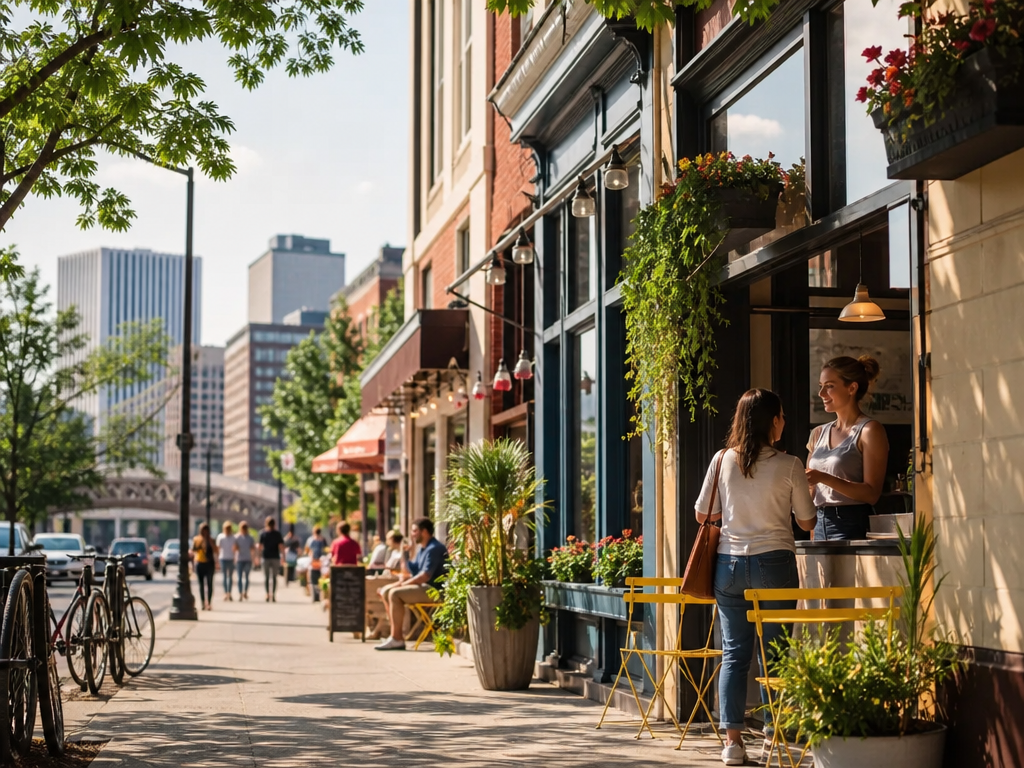
There’s a particular kind of stubbornness in Rochester, New York that doesn’t make the business press very often. It’s not the Silicon Valley pivot-and-raise kind, and it’s not the Miami flash-and-scale kind either. It’s the stubbornness of a city that watched Kodak collapse, watched Xerox shrink, watched Bausch & Lomb restructure, and decided to keep going anyway — neighborhood bakery by neighborhood bakery, machine shop by machine shop, independent bookstore by independent bookstore. If you want to understand what small business resilience actually looks like in practice, Rochester is a better classroom than most cities ten times its size.
I’ve spent time talking to owners across the Rochester business landscape over the past several years, and what strikes me most isn’t their ambition — though that’s there — it’s their clarity. They know their local market with a precision that would make a McKinsey consultant envious. They know which blocks have foot traffic on Saturday mornings and which don’t. They know that the Corn Hill neighborhood draws a different buyer than the South Wedge, and that East Avenue has its own rhythm entirely. This granular, almost obsessive knowledge of place is not quaint. It is a genuine competitive advantage, and it’s one that a small business owner in a larger, more anonymous city often never gets to develop.
Rochester’s population sits at roughly 210,000 in the city proper, with a metro area of about 1.1 million. That size is significant. It’s large enough to support real commercial diversity — you can find a serious craft cocktail bar, a Vietnamese-owned grocery, a precision machining supplier, and a contemporary art gallery all within a few miles of each other — but compact enough that word of mouth still functions as a primary marketing channel. When a rochester business gets a reputation, good or bad, that reputation travels fast and sticks. That cuts both ways, of course. But for operators who take quality seriously, it creates a loyalty loop that’s genuinely hard for outside competitors to break.
Consider what happened in the years after Kodak’s long decline accelerated in the 2010s. Conventional wisdom said Rochester was hollowing out. And in some respects, the numbers were grim: population declined, median household income lagged the state average, and commercial vacancy rates in certain corridors climbed. But something else was happening simultaneously. A generation of workers who had been laid off from large employers — engineers, chemists, logistics specialists, project managers — started businesses. Some were out of necessity. Many were out of conviction. The result was a surge in small business formation that the headline numbers about Rochester’s struggles tended to obscure.
The Small Business Administration’s data on new business applications in upstate New York tells part of this story, though the regional granularity is imperfect. What the data can’t capture is the texture of it: the former Kodak optical engineer who opened a custom lens fabrication shop on Culver Road; the logistics manager who left a legacy manufacturer to start a last-mile delivery company serving independent retailers; the food scientist who spent twenty years in a corporate lab and then opened a fermentation-focused provisions store in the Public Market neighborhood. These are not people who stumbled into small business. They arrived with deep technical knowledge, professional networks, and a specific frustration with how large organizations move — or fail to move.
Why the Local Market Rewards What Corporate Culture Punishes
One of the consistent themes I hear from Rochester business owners is that the local market actually rewards the things that got them pushed to the margins inside large companies: directness, specialization, and a refusal to sand down rough edges in the name of broad appeal. A small business in Rochester doesn’t need to be everything to everyone. It needs to be exactly the right thing for a few thousand people who will tell their friends.
This is not a romantic notion. It’s an economic model. The Rochester Public Market, which has operated continuously since 1905 and draws tens of thousands of visitors on weekend mornings, is a useful example. The vendors who thrive there are not the ones selling generic produce at commodity prices. They’re the ones who have planted unusual varieties, developed relationships with specific immigrant communities, or built a following around something genuinely distinctive — a particular style of tamale, a heritage breed of pork, a specific regional cheese. The market functions as a live laboratory for what the local market will actually sustain, and the lesson it teaches week after week is that specificity beats generality every time.
That lesson translates directly to the broader Rochester business environment. The independent coffee shops that have survived and grown — places like Fuego Coffee Roasters, which has expanded from a single location to multiple cafes and a roasting operation — did so by committing to a point of view rather than hedging toward the mean. The independent retailers that have held on in neighborhoods like the South Wedge and Park Avenue have done it by curating aggressively, by knowing their customers by name, and by treating the shopping experience as something worth designing rather than something that just happens.
None of this is effortless, and I don’t want to romanticize the difficulty. Running a small business in Rochester means navigating a commercial real estate market that has some genuinely distressed corridors alongside improving ones. It means working with a municipal permitting process that, like most mid-sized American city bureaucracies, can be slow and occasionally opaque. It means competing for skilled labor in a market where the University of Rochester and Rochester Institute of Technology produce talented graduates who often leave for larger metros. These are real friction points, and any honest account of the local market has to acknowledge them. The SBA’s Rochester district office offers resources specifically aimed at helping new and existing businesses navigate some of this complexity, from financing options to technical assistance programs, and it’s worth knowing that infrastructure exists.
But the friction is also, in a strange way, part of what makes the successes meaningful. A small business that survives five years in Rochester has genuinely earned it. The market doesn’t hand out participation trophies. What it does offer — and this is something I think gets underappreciated in conversations about secondary cities — is a kind of fidelity. When Rochester residents find a business they trust, they show up for it. They buy gift cards during hard times. They post on neighborhood forums when something threatens to close. They bring their out-of-town relatives specifically because they want to show them this place, this particular thing, that exists here and nowhere else. That relationship between a rochester business and its community is not a marketing strategy. It is the business model, fully expressed.
What Rochester’s small business scene ultimately demonstrates is something that’s easy to miss if you’re focused on the metrics of growth and scale: durability is its own form of success. The businesses that have been on Park Avenue for fifteen years, the machinist who has been supplying the same regional manufacturers for two decades, the bakery that has outlasted three rounds of neighborhood gentrification — these are not failures waiting to be disrupted. They are the connective tissue of a local economy, and they are teaching anyone willing to pay attention exactly how a small business actually survives the long game.
For entrepreneurs considering where to plant a flag, or for existing owners trying to understand what staying power actually requires, the Rochester model is worth studying carefully. Not because it’s perfect — it isn’t — but because it’s honest. It shows what happens when a local market and its businesses stop pretending to be something they’re not, and start competing on the one thing that can’t be replicated at scale: genuine, specific, hard-won knowledge of a place and the people who live there.